4
Unorthodox Idols
I felt it was important to explain why my greatest idols are not other writers. Don’t get me wrong, I admire many writers, but I find myself more drawn to film and television masterminds. I would say this is because when I read, I see a movie. When I write, I write a movie. Not a screenplay (I’ve tried that), but how a film would read in novel form. Even before getting a scene down on paper, I have to act it out. See how the dialogue flows. Imagine the position of the characters and a 360 degree setting. I try my best to create a moving picture. So, I suppose my admiration speaks for itself.
J.J. Abrams, James Cameron, Christopher Nolan. LOST, Avatar, Inception.
Their originality and unique transformation of old ideas is exactly the style I aim to achieve. The manner in which their stories are told holds the audience’s attention in an otherwise complex narrative. Their use of the camera is stunning. Perspective can have personality and these artists prove it. It doesn’t hurt they’re box-office favorites. I often gather inspiration from these three and after reviewing their work, I’ve found it comes down to another three simple factors:
Characters: Relatable no matter who, where or when they are.
Questions: Keep the audience on their toes. Get them invested.
Challenging Concepts: Simple should be made complicated.
Instead of awaiting a tome from my favorite authors (well, they’re either dead or done writing) I eagerly anticipate new shows or films from these innovative storytellers. I will review JJ’s newest program Alcatraz soon. Waiting for the Avatar sequels with bated breath. And July CANNOT bring the Dark Knight Rises here soon enough.
Even though these insights come from individuals involved in a different aspect of art, I feel many of the skills one creative employs can be transferred to the style of another. Whether it’s an episodic series, a canvas drawing or a spectacle on the silver screen, we’re all storytellers.
7 Simple Edits
Lately, I’ve been an editing fiend so I thought, “What better time than now to share my editing tips?” Yes, you read the correctly, editing tips. Sure, writing tips are helpful for the first run-through or so, but editing is an entirely different animal. And while the material on how to become a better writer is endless, resources for editing are few and far between. So here you are writers! Seven helpful editing tips!
Ok, actually, before you even start editing, be sure you’ve done the following:
Created an outline. Written a rough draft and reread your product. Formatted your story based on preliminary changes for a solid foundation.
There yet? Good. Now you’re ready to edit.
1- Read Out Loud: This is a step that will help you catch missing letters or small words like “to” that you may have skipped over during the first run-through. It will also show you awkward wording since I’ll bet you’ll find it awkward to read.
2- Finding Flow: You can’t jump from A to Z, there’s a whole alphabet of letters to pass through first. Your writing will sound choppy if your transitions weren’t smooth. Take the time to patch them up. You’ll find yourself sliding through the plot as opposed to stumbling.
3- Repetition: Thoughts get repeated. It’s a fact. You repeat yourself in writing. Just an avoidable truth. Whether its words or phrases, or even whole paragraphs, take into account where there’s repetition and take it out. There are exceptions, but that’s another post.
4- Show Don’t Tell: No one wants to read a lackluster story that answers everything for them. Paint a picture with your words! Lead readers down your carefully maintained trail, with excess information swept aside until you have them cornered in your woodland cabin. Alone. Terrified. I mean…until they are absorbed in the narrative and forget it’s not real.
5- Trim the Fat: On your editing journey, you will come across many unnecessary words, sentences, scenes, or pages even that add nothing but evil filler to your tale. Cut them out. It will be alright. Your novel will not only forgive you, but thank you for making it better.
6- Rinse and Repeat: Plain and simple. Once you’ve edited, you’ll probably feel the need to add new details and patch up your handiwork. Go ahead. Make some changes, reread and then edit again. And again. Sure, one more time.
7- Know When to Stop: Now stop it. You actually CAN edit too much. Unless you’re a professional editor, there are surely things you’ll miss. But before you hand your baby over, you can definitely polish your work to a shiny finish.
Leave a comment if you have specific editing questions or tips!
Musings on Adjectives and Adverbs: Don’t be Hatin’!
If you’ve learned anything about me by now, you know I like descriptors. I tend to go against the grain of conformity and feel a slight twinge when I hear people bashing my favorite parts of speech. Unlike most writers, adjectives and adverbs are my friends. I realize some people might now say, “But Rachel, those just clutter your writing.” Sure, I agree that’s possible. I approach descriptors as I would real friends. There’s no sense in collecting a gaggle of people to follow me around for no good reason. I choose them carefully.
That doesn’t detract from the blind hatred people express in their direction. Nouns may be the popular kid on the page, but they can’t survive without my friends. I defy anyone to explain the difference between a person, place or thing without adjectives. The questions nouns inherently create must be answered by descriptors. They’re what make your story interesting, your characters unique and your setting realistic. Otherwise, you would end up with some cave drawing of an epic tale:
Man asks other men to protect ring. They cross lands to a mountain. The ring is discarded.
Sure, it gets to the bare bones of the plot, but would you really want to read LotR diluted to such simple terms? I think not. Adjectives are necessary to add flavor and spice to nouns.
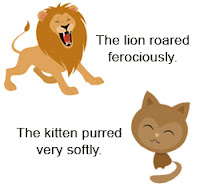
I will reiterate, select your descriptors with care. Don’t throw them into your writing willy-nilly. The last thing you want to create is confusion for your reader. Adverbs can sometimes be redundant when explaining verbs as in a sentence like:
Frodo quietly whispered, “Help!”
Readers know what an action looks or sounds like. Repeating the manner in which it takes place is counterintuitive. However, if you were to say:
Frodo whispered loudly, “Help!”
Then, I would side with the descriptor. One would expect a whisper to be quiet, but in this case it establishes a specific type of utterance that clarifies the scene.
I argue that the same confusion in a scene can be created by withholding descriptors as well. It becomes a fine-line to toe in order to successfully use adjectives and adverbs. Without descriptors, stories would never have evolved. Writers would not be able to create their own voice. Prose would have remained stagnant, unable to reach its rich and diverse potential that people create today. I wish writers would reconcile with descriptors instead of hating them for adding “nothing” to prose. Deep down you know that’s simply not true. They’re a crucial piece of your arsenal. Seriously.
Writer’s Sketch 6: Agent from the Black Lagoon
“Change it all!” the creature, hunched over a towering pile of papers, shouted. Beneath the desk, my knees clicked together as I accepted my red-blotched manuscript. The wheezing breath timed my flipping as I surveyed the damage. Pages-upon-pages with the dreaded red ‘X’, others trailed with a patchwork of corrections.
Swallowing the bullet of air lodged in my throat, I decided, against my better judgment, to protest. “I have to keep these scenes,” I said sheepishly, prodding the page in question. The depths of darkness further disguised the creature in a swath of shadows. It inched its bony elbows across the desk, and lowered a burning glare to eye-level. An urgent, overwhelming need for my mother crept into my frazzled thoughts. I did my best to return the intense eye-contact to no avail. My eyes watered and my lids did all they could to shield me from the searing disapproval.
“Re-write everything,” was the command. One might say it leaked from the creature in the form of a whisper, but in actuality, it was uttered from the corner of its mouth and strangled the air as it drifted to my ears. I began running my fingernails over my teeth. The slightest nibble pacified my shaking if only for a moment. “I noticed,” I began gingerly. “You cut this character entirely.”
A plume of smoke danced past my eyes. Could it have been from a cigarette? Not likely. It had been emitted from the creature’s incredulous snort. “Waste of ink. Not funny,” it replied. I wrung my hands together until the cracking bones snapped me back into reality. My fidgeting feet slipped. The stone tile beneath my feet had been polished by my shoe-soles into glass. One last pluck of courage bubbled through my system. “Did you like any of it?”
The echoes of cackling began in the pit of the creature’s stomach. Its amoeba-like shadow shifted with mirth. A snicker traveled up its throat until the burst of laughter crossed its lips; the creature rocked in its chair, reveling in hysteria.
Back to the drawing board.
Pitch Wars Mentee 2014

Awards


